Glazing, shading coefficient and materials for UAE summers: what the numbers on the glass mean
In July the UAE's mean maximum temperature reaches 39.7 to 43.8 degrees Celsius and a west-facing window turns afternoon sun into a cooling load that the DEWA bill pays for all summer. This article explains the three numbers on a glass specification, quotes the limits Al Sa'fat set for them in 2023, compares a real double-glazed unit and a window film, and gives the measured effect of external shading and of humidity on timber.
The UAE's July mean maximum is 39.7 to 43.8 degrees Celsius with humidity peaks of 64 to 81 percent
The UAE's July climate, in the long-term records of the National Center of Meteorology (NCM), has a mean temperature of 34.6 to 37.2 degrees Celsius, a mean maximum of 39.7 to 43.8 degrees, a mean minimum of 29.1 to 31.4 degrees, a mean relative humidity of 46 percent with mean maxima of 64 to 81 percent and mean minima of 19 to 36 percent, and a July record of 51.8 degrees at Mezaira in 2017, according to the NCM July climate summary reported by Aletihad on 2 July 2024. Those figures set the two loads a UAE interior has to survive: solar heat through glass by day, and humid air through every opening and every hour the air conditioning is off.
The numbers matter for an interior because the glass is the weakest part of the envelope. Al Sa'fat's 2023 edition allows an external wall U-value of 0.57 W/m2K but a glazing U-value of 2.1 W/m2K, so a square metre of compliant window lets through 3.7 times the conducted heat of a square metre of compliant wall, before any sunlight is counted. The sunlight is the larger term: a clear single pane passes 81 percent of the solar energy that strikes it, according to the 3M figures below.
A glazing specification carries three numbers: U-value, shading coefficient or SHGC, and light transmittance
A glazing specification in the UAE carries three numbers: the U-value in W/m2K, which measures conducted heat through the unit for each degree of temperature difference; the solar factor (g value, also called SHGC) or the shading coefficient (SC), which measure how much solar energy the unit lets through; and the visible light transmittance (VLT or LT), which measures how much daylight the unit lets through. The solar factor is a fraction of incident energy, so g 0.18 means 18 percent passes; the shading coefficient compares the unit with 3 mm clear glass, so a unit with SC 0.21 admits 21 percent of what clear glass would. The light to solar gain ratio (LSG), VLT divided by g, describes how much daylight a unit delivers per unit of heat.
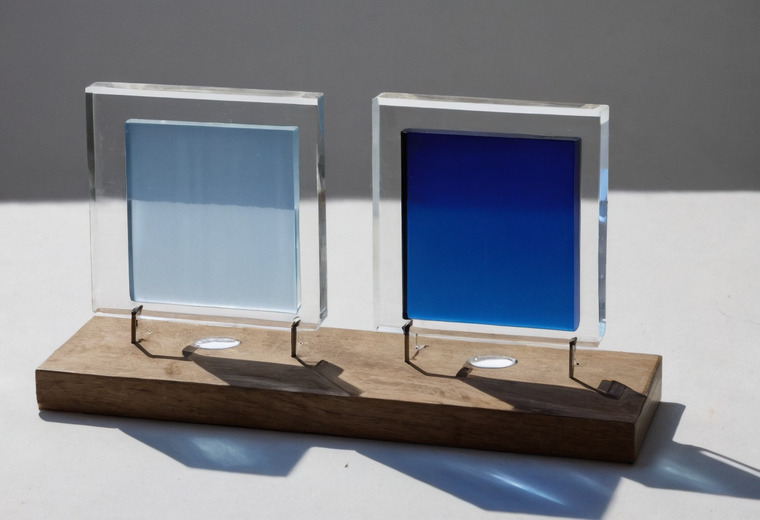
Guardian Glass publishes all three values for every product in its SunGuard range. The SunGuard SN 29/18 page, for a double glazed unit of 6 mm coated glass, a 16 mm cavity with 90 percent argon and 4 mm clear glass, gives a visible light transmittance of 29 percent, a solar transmittance of 16 percent, a solar factor (g) of 18 percent, a shading coefficient of 0.21, an ultraviolet transmittance of 14 percent and a U-value of 1.1 W/m2K, calculated to EN 410:2011 and EN 673:2011. The coating sits on surface 2, the inner face of the outer pane, and the unit's appearance is described as blue neutral.
| Value | Meaning | Guardian SN 29/18 double glazed unit |
|---|---|---|
| U-value (Ug) | conducted heat per square metre per degree | 1.1 W/m2K |
| Solar factor (g), SHGC | fraction of solar energy transmitted | 0.18 |
| Shading coefficient (SC) | solar gain relative to 3 mm clear glass | 0.21 |
| Visible light transmittance (VLT) | fraction of daylight transmitted | 29 percent |
| UV transmittance | fraction of ultraviolet transmitted | 14 percent |
| Light to solar gain ratio (LSG) | VLT divided by g | 1.6 |
Al Sa'fat 2023 sets glazing limits by window to wall ratio and caps residential glazing at 40 percent
The January 2023 edition of Al Sa'fat, the Dubai Green Building System, limits glazing by window to external wall ratio in tables 501.01(2) to 501.01(4): below 40 percent glazing, a maximum summer U-value of 2.1 W/m2K, a maximum shading coefficient of 0.4 and a minimum light transmittance of 0.4 for Silver Sa'fa, tightening to 1.9, 0.32 and 0.32 for Golden and Platinum; at 40 to 60 percent glazing, 1.9, 0.32 and 0.32 for Silver and 1.7, 0.25 and 0.25 for the upper tiers; above 60 percent, 1.7, 0.25 and 0.25 for Silver and 1.5, 0.25 and 0.25 for the upper tiers. The Al Sa'fat second edition caps the window to wall ratio of conditioned spaces at 40 percent of gross wall area for residential buildings and 60 percent for other building types, requires the average envelope U-value of a villa not to exceed 0.40 W/m2K, and, for Golden and Platinum buildings, requires glazing that faces between southeast and southwest (112.5 to 247.5 degrees) to be treated environmentally.
The Guardian unit above meets the tightest row of the table with margin, at U 1.1 and SC 0.21, but its 29 percent light transmittance falls below the 0.32 minimum for the upper tiers at 40 to 60 percent glazing and the 0.4 minimum for Silver below 40 percent. The minimum light transmittance exists because a dark glass that blocks heat also blocks daylight and drives the lighting load up, which is why the regulation limits both directions. A villa owner choosing glass in Dubai therefore needs a unit that satisfies a floor on daylight as well as ceilings on heat, and the full set of Al Sa'fat clauses that apply to an interior is collected in the article on Al Sa'fat and Estidama requirements.
Window film cuts the solar factor of clear glass from 0.81 to 0.50 without changing the frame
A spectrally selective window film applied to existing glass reduces the solar factor of single clear glass from 0.81 to 0.50 and cuts heat gain by 38 percent, according to the 3M Prestige 70 product bulletin dated April 2026, which calculates its values to EN 410. On double clear glass the same film lowers the solar factor from 0.70 to 0.58 and heat gain by 17 percent, and on double tinted glass from 0.49 to 0.41 with a 16 percent reduction; ultraviolet rejection rises to 99.9 percent in every case.
| Glass (3M bulletin, April 2026, EN 410) | VLT without film | g without film | VLT with Prestige 70 | g with Prestige 70 | Heat gain reduction |
|---|---|---|---|---|---|
| Single clear | 89 percent | 0.81 | 70 percent | 0.50 | 38 percent |
| Single tinted | 53 percent | 0.61 | 42 percent | 0.40 | 34 percent |
| Double clear | 79 percent | 0.70 | 63 percent | 0.58 | 17 percent |
| Double tinted | 47 percent | 0.49 | 37 percent | 0.41 | 16 percent |
The bulletin states an application temperature of 8 to 45 degrees Celsius and a service temperature of minus 40 to plus 80 degrees, and gives final adhesion after 8 to 10 days at 18 degrees, which in a UAE summer means the film is applied to the interior face of the glass in a cooled room. The table shows where film pays: on the single or double clear glass that older Dubai villas carry, where the solar factor is far above the 0.4 shading coefficient that Al Sa'fat allows for new work, and much less on glass that is already tinted or coated.
External shading of 60 cm cuts solar gain by 27 percent in an Abu Dhabi house simulation
External shading devices of 60 cm projection, horizontal and vertical combined, cut solar heat gain by 27 percent and annual cooling load by 4 percent in a simulated residential house in Abu Dhabi, and the optimal combination of improved windows and shading cut cooling load by 10 percent and annual energy use by 6 percent, according to the AESG study of 6 January 2019. The base case in that study was double clear glass in aluminium frames with a U-value of 3.4 W/m2K and an SHGC of 0.7, which describes a large share of the existing villa stock, and the individual results were 1.3 percent for a 30 cm horizontal device, 0.9 percent for a 30 cm vertical device, 2.3 percent for the two combined at 30 cm, and 2.4, 1.6 and 4 percent at 60 cm.
The Pearl Villa Rating System's shading credit, described in the article on Al Sa'fat and Estidama, asks for the same geometry in words: a mashrabiya-style vertical blind system with at most 20 percent free area on east and west facades and a horizontal projection at least as wide as the glazed unit on the south facade. A shading device also protects the interior finishes. Velvet on a majlis wall, oiled timber on a floor and lacquer on a cabinet door all sit in the path of that sun, and the seating dimensions in the article on majlis planning in a UAE villa show how much upholstered surface a reception room exposes to its windows.
Humidity moves solid timber three times as much as engineered timber
Solid rift white oak flooring expanded 1.6 percent in width, about 1/16 of an inch on a 4 inch board, when its moisture content rose from 7.4 to 14.8 percent, while engineered rift white oak with the same face expanded 0.5 percent, according to a test published by Hardwood Floors Magazine on 3 December 2018. The test started the 4 inch by 33.5 inch specimens at 75 degrees Fahrenheit and 35 percent relative humidity, a 6.8 percent equilibrium moisture content, and measured thickness swell of 1.7 percent for solid and 2.8 percent for engineered boards, with length change of about 0.1 percent for both.
The moisture content range in that test is the range a UAE home passes through in one summer. The NCM July figures above give mean maximum humidity of 64 to 81 percent outdoors; an air conditioned interior at 24 degrees and 50 percent relative humidity, the earlier Al Sa'fat design condition, holds timber near the low end of the test, and a villa left with the cooling off for a fortnight in August lets the interior climb toward the outdoor humidity and the high end. A 4 metre run of solid oak boards at 1.6 percent gains 64 mm across the room; the same run in engineered boards gains 20 mm. The following rules follow from the measured figures:
- Specify engineered boards, or solid boards in narrow widths, in any room where the air conditioning may be switched off in summer.
- Keep the expansion gap at the perimeter and at door thresholds sized for the wider of the two seasonal states, not the installation day.
- Condition timber, veneered panels and joinery inside the cooled building before fixing, and keep the cooling running from delivery to handover.
- Keep direct sun off timber and fabric with external shading or a low solar factor glass, because surface heating dries the face of the board faster than the core.
- Put the room's humidity range in the joinery specification, so the maker can choose the substrate moisture content to match.
The cost of the cooling that holds those conditions is set out in the article on DEWA tariffs and cooling loads, where the 10 percent rise in AC energy per degree reported by The National meets the 38 percent heat gain reduction that a film can deliver on the glass that admits the heat in the first place.
Questions readers ask about this topic
- What is the difference between SHGC and shading coefficient?
- Both describe how much solar energy passes through a glazing unit. The solar factor or g value (SHGC) is the fraction of incident solar energy transmitted, so 0.18 means 18 percent; the shading coefficient compares the unit with 3 mm clear glass. Al Sa'fat uses the shading coefficient; the Pearl Villa Rating System uses SHGC. Guardian's SN 29/18 double glazed unit lists both: g 18 percent and SC 0.21.
- What glazing values does Al Sa'fat require in Dubai?
- For a window to external wall ratio below 40 percent, table 501.01(2) of the January 2023 edition sets a maximum summer U-value of 2.1 W/m2K, a maximum shading coefficient of 0.4 and a minimum light transmittance of 0.4 for Silver Sa'fa, and 1.9, 0.32 and 0.32 for Golden and Platinum. Residential buildings are capped at a 40 percent window to wall ratio.
- Does window film reduce heat gain in Dubai?
- 3M's April 2026 product bulletin for Prestige 70 film gives, for single clear glass, a fall in solar factor from 0.81 to 0.50 and a 38 percent reduction in heat gain, and for double clear glass a fall from 0.70 to 0.58 and a 17 percent reduction, calculated to EN 410. The film is applied between 8 and 45 degrees Celsius.
- How much does external shading cut cooling load?
- AESG's 2019 simulation of a residential house in Abu Dhabi found that combined horizontal and vertical shading devices of 60 cm projection cut solar heat gain by 27 percent and annual cooling load by 4 percent, and that the optimal combination of better windows and shading cut cooling load by 10 percent and annual energy by 6 percent.
- Does solid timber flooring move in UAE humidity?
- A 2018 test published by Hardwood Floors Magazine found that solid rift white oak expanded 1.6 percent in width when its moisture content rose from 7.4 to 14.8 percent, against 0.5 percent for engineered oak of the same face, which is the reason to specify engineered boards for rooms where the air conditioning is switched off in summer.
Topics: SHGC, shading coefficient, U-value glazing, low-e glass UAE, window film Dubai, external shading mashrabiya, timber flooring humidity UAE.